
Abstract
The tennis forehand and backhand are still commonly described and taught as arm swings, even though the biomechanics literature describes groundstroke production as a linked, proximal-to-distal kinetic chain. This review examines evidence on pelvis and trunk angular velocity, shoulder translation, upper-limb joint contributions to racquet velocity, backhand trunk contribution, impact attenuation, and forearm electromyography.
The central argument is intentionally narrower than the slogan used in coaching: the arms are not mechanically inactive, but they should not function as an independent primary engine for racquet acceleration. Elite forehand players demonstrate substantially greater pelvis and upper-trunk angular velocities at impact than high-performance players, and better timing of these rotational velocities is associated with higher shoulder and racquet velocities. At the same time, upper-arm horizontal flexion, elbow extension, and upper-arm internal rotation measurably contribute to racquet velocity, showing that the arm is an active distal link rather than a passive rope.
Experienced players also attenuate substantially more impact shock before it reaches the elbow than recreational players. Taken together, the evidence favors a model in which the lower body and trunk establish and transport motion, while the upper extremity transmits, shapes, and adds to that motion. The coaching implication is straightforward: use the arm to organize the swing path and contact, not to rescue a stroke that the rotational chain failed to create.
Keywords: tennis biomechanics; forehand; backhand; kinetic chain; trunk rotation; racquet velocity; shoulder rotation; impact attenuation
Introduction
One phrase I use constantly when teaching tennis is: the arms are not the engine. The point is not that the arm does nothing. That would be easy to disprove. The shoulder rotates, the upper arm moves relative to the trunk, the elbow changes position, the forearm rotates, and the hand organizes the racquet. The point is that an efficient groundstroke should not require the player to consciously manufacture power by throwing the arm at the ball. The arm is working at the distal end of a system that is already moving.
The useful scientific question, then, is not whether the arm contributes to racquet-head velocity. It does. The question is how that contribution is organized. Reviews of forehand mechanics identify axial pelvis rotation, trunk rotation, shoulder horizontal adduction, and upper-arm internal rotation as primary contributors to racquet speed [1]. Groundstroke mechanics are therefore better described as linked-segment motion than as an isolated arm swing. This paper compiles that literature and then tests the model against visual positions repeatedly seen in elite professional players.
Biomechanical Framework: A Linked Rotational System
The kinetic-chain model describes force and motion moving through sequential body segments. In tennis, the lower extremities, pelvis, trunk, shoulder complex, elbow, wrist, hand, and racquet form linked elements that can absorb, generate, and transfer energy [2,3]. If a proximal link is poorly timed or contributes too little, distal structures must compensate. Clinical reviews of tennis injuries specifically note that recreational players often use excessive and poorly coordinated muscular effort that does not translate proportionally into ball velocity and can increase joint loading [3].
That framework matters because the hitting arm is not attached to a stationary base. When the trunk rotates, the shoulder travels. When the shoulder travels, the upper arm begins its motion from a moving reference frame. The arm can then add segmental rotation and fine control to velocity that already exists. This is the distinction behind the title: movement of the arm is not the same thing as the arm being the engine.
Conceptual proximal-to-distal kinetic chain for the groundstroke. The labels “primary proximal drive” and “transmission + shaping” are coaching abstractions, not claims that distal segments perform zero mechanical work.
Visual Prediction of the Rotational Model
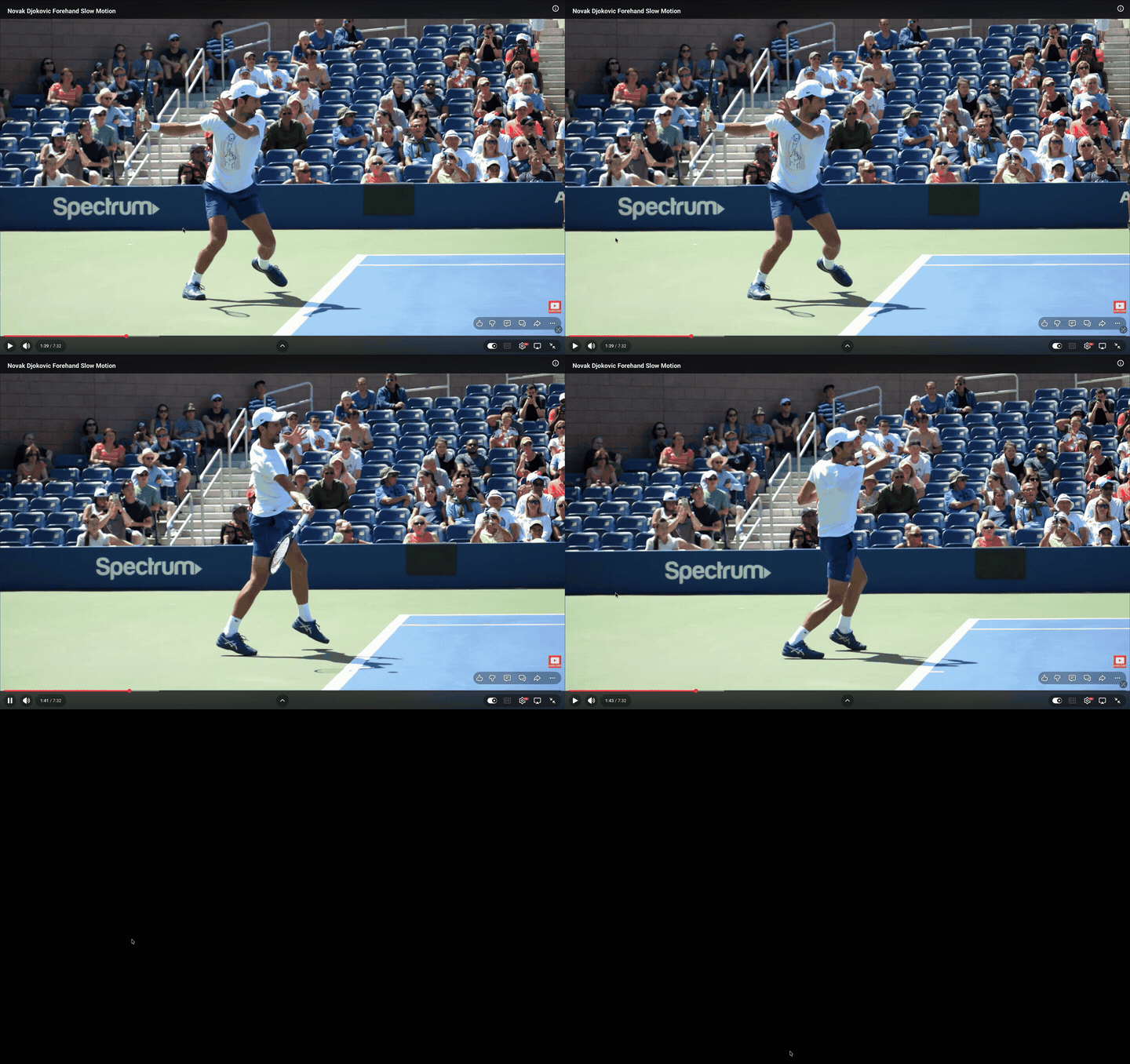
Still photography cannot measure torque, muscle activation, or segmental power, so photographs should not be used as stand-alone proof of force production. They can, however, test whether elite positions are consistent with a model derived from motion-capture research. If the torso remained substantially sideways while an independent arm swing supplied most forward acceleration, elite contact photographs should regularly show that geometry. Instead, elite forehands commonly show substantial trunk unwinding by or around contact. The exact shoulder angle varies with stance, direction, ball height, and player.
Video reference: watch how the body and racquet move as one linked sequence rather than as an isolated arm swing.
Elite Players Rotate Faster at Impact
Landlinger et al. recorded 43 three-dimensional marker trajectories from six elite and seven high-performance players with an eight-camera, 400-Hz Vicon system. At impact, the elite group showed a shoulder linear velocity of 2.0 m/s versus 1.2 m/s, pelvis angular velocity of 295 deg/s versus 168 deg/s, and upper-trunk angular velocity of 453 deg/s versus 292 deg/s [4]. Those differences correspond to approximately 67% greater shoulder linear velocity, 76% greater pelvis angular velocity, and 55% greater upper-trunk angular velocity in the elite group. The elite group also showed a tendency toward greater racquet velocity.
These findings do not prove that trunk rotation alone creates the shot. They do show that the better players reached impact with a markedly faster proximal system. That matters because the shoulder is the base from which the arm operates. A distal segment attached to a faster-moving proximal base does not need to manufacture the same amount of velocity independently.
Pelvis and upper-trunk angular velocities at impact in elite versus high-performance players. Data from Landlinger et al. [4].
Timing Matters More Than Simply “Turning More”
A later study using the same general elite-versus-high-performance comparison found that maximum pelvis and trunk angular velocities occurred closer to impact in the elite group. Peak pelvis angular velocity occurred about 0.075 s before impact in elite players versus 0.093 s in high-performance players; peak trunk angular velocity occurred about 0.057 s before impact versus 0.075 s [5]. Elite players also tended to achieve higher peak horizontal shoulder velocity (3.0 versus 2.5 m/s) and racquet velocity (33.1 versus 31.1 m/s). The authors identified the later occurrence of maximum pelvis and trunk rotations as the main reason for the tendency toward greater shoulder and racquet velocities [5].
The Arm Is Active. That Still Does Not Make It the Engine.
The strongest objection to the title is also the easiest one to answer. Studies that isolate upper-limb contributions show that the arm contributes substantially to racquet velocity. In elite attacking forehands, Pedro et al. reported that upper-arm horizontal flexion contributed approximately 48.1% of anteroposterior racquet velocity in cross-court shots and 45.2% in inside-out shots. Elbow extension contributed 17.3% and 20.9%, while upper-arm internal rotation contributed 15.6% and 14.2%, respectively [6].
Those numbers are important because they prevent the model from turning into a slogan that overreaches the evidence. The arm is not passive. But upper-arm horizontal flexion and internal rotation occur around a shoulder that has itself been transported by pelvis and trunk motion. Segmental contribution therefore cannot be equated with a coaching instruction to consciously push the arm harder toward the ball. The better distinction is coordinated distal contribution versus independent distal effort.
Racquet Lag: An Effect of Sequencing, Not a Pose
The rotational model also offers a cleaner explanation of racquet lag. If proximal segments begin accelerating while the distal racquet initially remains behind, the racquet necessarily trails. The visual ‘lag position’ is therefore consistent with proximal-to-distal sequencing rather than something that must be frozen into place with the wrist.
The Backhand: Same Principle, Different Distribution
Backhand mechanics are useful because the one- and two-handed strokes distribute work differently. In a laboratory study of 10 tennis coaches, the mean component of racquet-handle velocity attributable to trunk rotation at contact was 0.94 m/s for the one-handed backhand and 2.09 m/s for the two-handed backhand [7]. A later review reached the same broader conclusion: two-handed backhands rely more on trunk rotation for racquet velocity, while one-handed backhands depend more on segmental rotations of the upper limb [8].
That does not weaken the kinetic-chain model. It makes it more precise. ‘The arms are not the engine’ is not a claim that every stroke allocates mechanical work identically. The one-hander is a useful stress test because it visibly requires more distal freedom. Yet even there, the arm begins from a body that has organized the stroke proximally.
Recreational Players Absorb More Distal Shock
Wei et al. compared 24 experienced and recreational male players during the backhand. Experienced players reduced racquet impact transmitted to the elbow by 89.2%; recreational players reduced it by only 61.8%. The largest EMG differences occurred during follow-through, when experienced players remained at submaximal wrist-flexor and wrist-extensor activity while recreational players maintained maximal or supramaximal activity [9].
The result fits the larger kinetic-chain argument. The recreational player often produces more visible muscular effort at the distal end of the chain while transmitting more shock toward the elbow. The experienced player can create a faster, heavier shot while allowing the system to absorb and redistribute the collision more effectively. Clinical reviews likewise describe skill level, technique, kinetic-chain integrity, and excessive upper-extremity loading as relevant injury considerations, although upper-limb injury is multifactorial and should not be reduced to one technical fault [2,3,10].
Impact attenuation between racquet and elbow during backhand strokes. Data from Wei et al. [9].
Why Clean Contact Can Feel Like a Pillow
I often tell players that clean contact should feel like a pillow. That is a sensory cue, not a literal statement about impact force. The ball-racquet collision is violent on a short time scale. The useful point is that the player should not need to brace the arm and fight that collision. If the racquet arrives with momentum through an organized chain and the follow-through continues, high ball speed can coexist with surprisingly little harsh sensation in the arm.
The Wei et al. findings do not prove the ‘pillow’ cue directly, but they give it a plausible mechanical basis: experienced players transmitted much less shock toward the elbow while using less extreme forearm activation during follow-through [9]. The sensation I want is therefore not softness in the ball. It is the absence of unnecessary fight in the arm. More ball. Less fight.
Coaching Application: Why I Prefer a More Complete Preparation
Some coaches initially set the racquet more to the side and allow the backswing to finish later. That can work, and elite players use many different preparation shapes. I do not think the literature currently proves that one takeback is universally superior. The forehand review literature explicitly notes that longitudinal work on teaching methodologies remains limited [1].
My concern is motor behavior. If a developing player begins the forward phase with the racquet still beside the body, the simplest solution is often to send the arm forward. If the racquet is already organized farther behind the rotational path, the player has a different problem to solve: the racquet is behind, the contact is ahead, and rotation becomes the obvious way to transport it. That is why I prefer a more complete preparation as a teaching constraint. It makes it harder for the arm to cheat. This is a coaching inference from the biomechanical model, not an experimentally settled conclusion.
Discussion
The strongest version of this argument is not that the arm generates no force. The literature clearly rejects that. The shoulder and upper arm are major contributors to racquet-head velocity [1,6], and the one-handed backhand relies even more heavily on distal segmental rotations [8]. The stronger and more defensible claim is that the arm should not be coached as an independent primary engine.
Three findings converge on that interpretation. First, elite forehand players reach impact with much greater pelvis, trunk, and shoulder velocities than high-performance players [4]. Second, the timing of peak pelvis and trunk rotation closer to impact differentiates elite players and is associated with higher shoulder and racquet velocities [5]. Third, recreational players transmit more impact shock to the elbow and maintain more extreme forearm muscle activation during follow-through [9].
The elite photographs are useful because they make those measurements visible. They should not be presented as force data. They are positional evidence that matches the kinematic research: by the time the racquet reaches the ball, the torso has already moved significantly from the loaded preparation. The hitting arm is operating from a moving shoulder, not from a torso frozen sideways.
Limitations
Several limitations matter. First, much of the groundstroke literature uses small samples because high-speed three-dimensional biomechanical testing is expensive and difficult with elite players. Second, laboratory tasks cannot fully reproduce the variability of live match play. Third, joint-contribution estimates depend on the mathematical model and the direction of racquet velocity being analyzed. Fourth, still photographs cannot establish causality, torque, EMG, or energy flow; they can only illustrate positions consistent with measured kinematics. Fifth, injury is multifactorial. Technique, exposure, equipment, age, strength, fatigue, previous injury, and individual anatomy all matter [10]. Finally, the coaching claim concerning fuller racquet preparation is a hypothesis derived from the kinetic-chain model and coaching observation, not a conclusion directly tested by the studies reviewed here.
Conclusion
The arms are not the engine is useful precisely because it changes what the player tries to do. The phrase should not be read as a literal claim that the shoulder, elbow, forearm, or hand contribute zero mechanical work. They do. The evidence instead supports a linked system in which proximal rotation creates and transports substantial motion before the distal segments finish the job.
Elite players rotate the pelvis and upper trunk faster at impact, time those rotations closer to contact, and move the shoulder faster through space. Upper-limb rotations then contribute materially to racquet velocity from that moving base. Experienced players also attenuate more impact before it reaches the elbow than recreational players.
So the practical model is simple: the body establishes the ride; the arm shapes it. The arm controls path, spacing, face orientation, contact, and the final distal contribution to racquet speed. What it should not have to do is rescue a stroke that never got moving upstream.
References
- Reid, M., Elliott, B., & Crespo, M. (2013). Mechanics and learning practices associated with the tennis forehand: a review. Journal of Sports Science and Medicine, 12(2), 225-231.
- Gil, J. A., et al. (2019). Hand and Wrist Injuries in Tennis Players. Current Reviews in Musculoskeletal Medicine, 12, 87-97.
- Chung, K. C., et al. (2016). Upper Extremity Injuries in Tennis Players: Diagnosis, Treatment, and Management. Hand Clinics, 32(4), 557-568.
- Landlinger, J., Lindinger, S. J., Stöggl, T., Wagner, H., & Müller, E. (2010). Kinematic differences of elite and high-performance tennis players in the cross court and down the line forehand. Sports Biomechanics, 9(4), 280-295.
- Landlinger, J., Stöggl, T., Lindinger, S., Wagner, H., & Müller, E. (2012). Key factors and timing patterns in the tennis forehand of different skill levels. Journal of Sports Science and Medicine, 11(4), 643-651.
- Pedro, B., Veloso, A., Cabral, S., Lara, J. P. R., João, F., & Carvalho, J. (2022). Evaluation of Upper Limb Joint Contribution to Racket Head Speed in Elite Tennis Players Using IMU Sensors. Sensors, 22(3), 1283.
- Stępień, A., Bober, T., & Zawadzki, J. (2011). The Kinematics of Trunk and Upper Extremities in One-Handed and Two-Handed Backhand Stroke. Journal of Human Kinetics, 30, 37-47.
- Genevois, C., Reid, M., Rogowski, I., & Crespo, M. (2015). Performance Factors Related to the Different Tennis Backhand Groundstrokes: A Review. Journal of Sports Science and Medicine, 14(1), 194-202.
- Wei, S.-H., Chiang, J.-Y., Shiang, T.-Y., & Chang, H.-Y. (2006). Comparison of shock transmission and forearm electromyography between experienced and recreational tennis players during backhand strokes. Clinical Journal of Sport Medicine, 16(2), 129-135.
- Kekelekis, A., Nikolaidis, P. T., Moore, I. S., Rosemann, T., & Knechtle, B. (2020). Risk Factors for Upper Limb Injury in Tennis Players: A Systematic Review. International Journal of Environmental Research and Public Health, 17(8), 2744.